


Table of Contents
- The Real Cost of Shop Downtime in Auto Body Repair
- Calculating the Cost of Machine Downtime
- Your Preventive Maintenance Checklist for Shop Equipment
- Predictive Maintenance Tools for Collision Repair
- Retrofitting Legacy Equipment for Modern Reliability
- Building Supply Chain Resilience for Spare Parts
- Conclusion
- Frequently Asked Questions
Last Updated: September 25, 2026
The Real Cost of Shop Downtime in Auto Body Repair
Reducing shop downtime with reliable machinery starts with understanding what downtime actually costs you. Downtime is any period when a bay sits idle because equipment isn’t working. That includes breakdowns, waiting on parts, and time spent hunting for a fix.
Here’s what most shop owners miss: the machine is rarely the biggest expense. The idle tech standing next to it usually is.
Planned vs. Unplanned Downtime
Planned downtime is time you schedule in advance, like a fluid change or a calibration check. Unplanned downtime is the breakdown you didn’t see coming, and it costs far more because you can’t route work around it.
A common mistake is treating all downtime the same. Scheduled maintenance costs you a few hours you already budgeted for. A frame machine that dies mid-job costs you that job, the next one, and your customer’s trust.
- Planned: oil changes, filter swaps, calibration, inspections
- Unplanned: sudden failures, part shortages, surprise electrical faults
- The difference: control. Planned downtime is a choice. Unplanned downtime makes the choice for you.
Calculating the Cost of Machine Downtime
The true cost of machine downtime is lost labor plus lost revenue plus recovery time, not just the repair invoice. Most shops never run this number, which is why they keep getting blindsided.
A Simple Formula for Your Shop
Use this to estimate what one down machine costs you per day:
Downtime Cost = (Idle tech hours × labor rate) + (Jobs delayed × average job value) + Repair cost
Here’s a worked example for a shop with three techs:
| Cost Factor | Example Figure | Notes |
|---|---|---|
| Idle tech hours | 8 hours | One full shift, three techs |
| Labor rate | Your posted rate | Use your own shop rate |
| Jobs delayed | 2 jobs | Typical for a busy day |
| Average job value | Your average ticket | Pull from last month |
| Repair cost | Parts + labor | From your vendor quote |
Run this once and you’ll see why a spare machine or a fast repair matters more than the sticker price. For shops tracking this formally, the EPA’s guidance on environmental compliance for auto shops is a useful reminder that equipment upkeep also keeps you on the right side of regulations.
The most expensive downtime is the kind you discover at 4 p.m. on a Friday. If your only welder fails then, you lose the weekend and Monday’s jobs. Keep a backup plan for your single-point-of-failure machines.
Your Preventive Maintenance Checklist for Shop Equipment
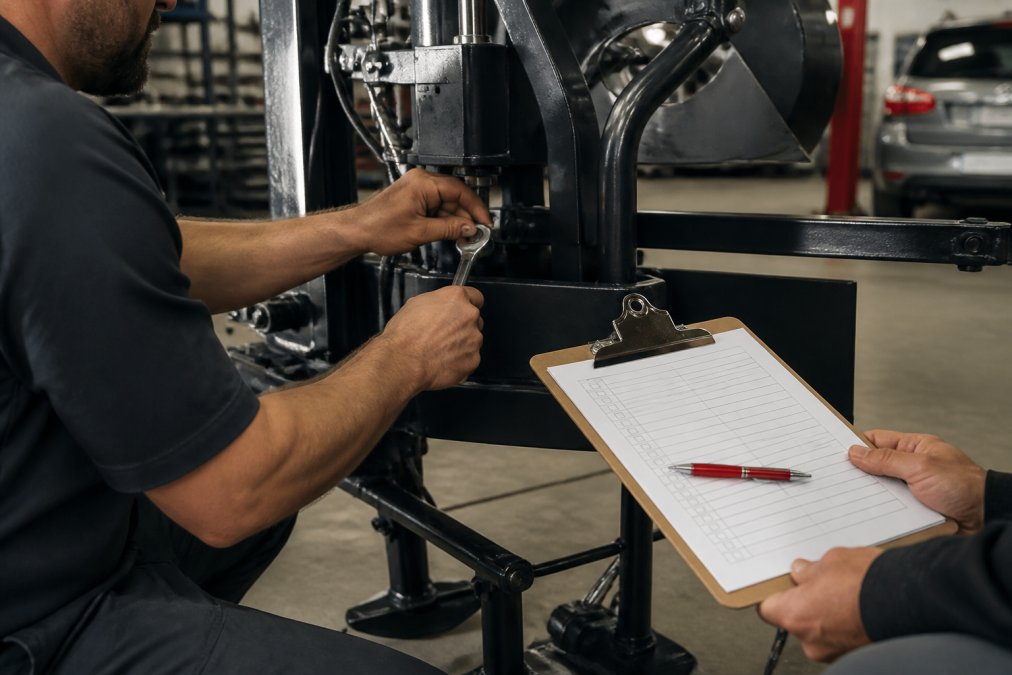
A preventive maintenance checklist for shop equipment is a written schedule of inspections and service tasks that keeps machines running before problems start. It turns guesswork into a routine. But a checklist that treats every task as equally important is just as useless as no checklist at all, it burns tech hours on low-stakes items while the machine that actually halts production quietly degrades.
Step 1: Rank Your Machines by Criticality, Not by Convenience
Before you write a single task, list every machine in the shop and score it on two axes:
- Failure frequency, how often has it gone down in the last 12 months?
- Production impact, if it stops, how many bays go idle?
A frame machine that fails twice a year but halts three bays outranks a compressor that hiccups monthly but only slows one tech.
Subscribe to our newsletter! →
- A machines: one failure stops the shop. Daily checks, monthly professional service, spare parts on the shelf.
- B machines: one failure slows a bay. Weekly checks, quarterly service.
- C machines: one failure is an inconvenience. Monthly checks, service when the schedule allows.
Step 2: Build the Checklist Around Your A Machines
Split tasks by frequency, but weight them toward the machines that hurt most:
- Daily: check fluid levels on A machines, inspect cables and hoses, listen for odd noises
- Daily: wipe down sensors and check for loose fittings on lifts and frame racks
- Weekly: inspect lift hydraulics, test emergency stops, check air pressure
- Weekly: tighten fasteners on high-vibration equipment (welders, compressors, pullers)
- Monthly: change filters, inspect wiring, lubricate moving parts on A and B machines
- Monthly: review error logs and note repeat issues
- Quarterly: professional calibration and alignment checks on A machines
- Annually: full structural inspection of frame machines, lifts, and overhead equipment
Step 3: Run the ROI Math Before You Add a Task
Annual task cost = (Minutes per check × Checks per year × Loaded labor rate) ÷ 60
Photograph each machine’s “normal” state when it’s new. When something looks off weeks later, you’ll have a baseline to compare against instead of relying on memory. Pair the photo with a one-line note on the machine’s last service date so the next tech inherits context, not a mystery.
Predictive Maintenance Tools for Collision Repair
Predictive maintenance tools for collision repair use sensor monitoring and machine data to flag problems before a machine fails. Instead of fixing on a schedule, you fix when the data says it’s time. That definition is easy to find. What’s harder to find is advice for the shop running a 2008 frame machine, a 2012 welder, and a compressor with no data port in sight.
The Three Tiers of Predictive Monitoring
Think of predictive maintenance as a ladder, not a switch. You climb it as your budget and your machines allow.
- Vibration feel (hand on the housing, note any change in intensity)
- Operating temperature (infrared thermometer, roughly $30-$80 at any industrial supplier)
- Sound signature (a phone recording of the machine running normally, compared week to week)
Sequencing Your Rollout
What most guides miss is the order of operations. Don’t buy sensors for every machine at once, and don’t wait until you can afford Tier 3 everywhere.
- List your machines by how often they fail and how much it hurts when they do (your criticality ranking from the checklist section).
- Start with the A machine that hurts most when it stops.
- Apply the highest tier it can support, Tier 1 if it’s fully analog, Tier 2 if it has a motor or pump you can instrument.
- Track readings for a month to establish a baseline.
- Set a warning threshold at roughly 10-15% deviation from baseline.
- Expand to the next machine once the first one proves its value.
You don’t need a connected machine to do predictive maintenance. A thermometer, a phone, and a weekly log will catch most failures on legacy equipment. Add bolt-on sensors when the manual method proves its value, and upgrade to native monitoring only when you replace the machine.
Retrofitting Legacy Equipment for Modern Reliability
Retrofitting legacy equipment means upgrading older machines with modern controls, sensors, or components instead of replacing them outright. For shops running solid-but-old iron, it’s often the smartest money you’ll spend.
- Worth retrofitting: strong frames, good motors, machines central to your workflow
- Not worth it: cracked structures, obsolete parts with no supply, units you rarely use
- The middle ground: retrofit the core, replace the accessories
Retrofitting usually beats replacing when the machine’s structure is sound and parts are still available. When the frame or motor is failing, replacement wins. Match the decision to the machine, not to a blanket rule.
Building Supply Chain Resilience for Spare Parts
Supply chain resilience for spare parts means keeping critical components on hand or having a verified backup source, so a single delayed shipment can’t idle your shop. This is the gap most maintenance guides skip entirely.
- Identify your single-point-of-failure parts (the ones with no substitute)
- Keep one spare of each critical component on the shelf
- Track lead times and reorder before you hit the buffer
- Build a relationship with a supplier who answers the phone on a Friday
Smaller shops with 5 bays or fewer: focus your spare-parts budget on the two or three machines that would halt everything if they failed. You don’t need a full warehouse, just insurance on your bottlenecks.
Conclusion
Downtime is a choice you make in advance, whether you realize it or not. Shops that plan maintenance, track their real costs, and keep critical spares on the shelf lose far fewer production days than shops that react.
Frequently Asked Questions
How do you reduce machine downtime in an auto body shop?
Reducing shop downtime starts with a mix of preventive and predictive maintenance. Implement a daily and weekly checklist for critical machinery, use sensors to monitor equipment health, and keep a small inventory of high-wear spare parts on hand. Training technicians to spot warning signs early also helps. The goal is to shift from reactive repairs to a planned maintenance schedule that keeps your most important equipment running when you need it.
How do I calculate the cost of equipment downtime for my shop?
To calculate the cost of machine downtime, multiply your shop’s average hourly labor rate by the number of hours a machine is out of service. Then add any lost revenue from jobs that had to be delayed or outsourced. For a more complete picture, include overtime pay for catch-up work and any expedited shipping fees for parts. This number helps you justify investments in more reliable machinery or a preventive maintenance program.
What is the difference between reactive and proactive maintenance?
Reactive maintenance means fixing equipment only after it breaks, which often leads to unplanned downtime and higher costs. Proactive maintenance, which includes preventive and predictive strategies, involves scheduled inspections and repairs to prevent failures before they happen. For a busy auto body shop, proactive maintenance is almost always more cost-effective because it reduces emergency repairs and keeps your production schedule on track.
Why is investing in high-quality machinery critical for shop efficiency?
High-quality machinery is built to handle the daily wear and tear of a busy shop, which means fewer breakdowns and less unplanned downtime. Reliable equipment also produces more consistent results, reducing rework and improving cycle times. While the upfront cost may be higher, the long-term savings from reduced maintenance, less downtime, and higher customer satisfaction often outweigh the initial investment.

