

Table of Contents
- How to Choose Professional Auto Body Welding Equipment
- MIG vs. TIG vs. Spot Welding for Collision Repair
- Top Auto Body Welding Equipment for Professional Shops
- Aluminum Repair Welding Tools for Modern Vehicles
- Preventing Warping on Thin Sheet Metal
- Welding Safety Equipment Every Shop Needs
- Collision Repair Equipment Financing Options
- Auto Body Shop Equipment ROI: What to Expect
Last Updated: August 29, 2026
Choosing the wrong welder for collision repair compromises structural integrity, voids OEM certifications, and costs insurance approvals. Modern vehicles use advanced high-strength steels, boron alloys, and aluminum panels that demand different welding processes than mild steel work from a decade ago. This guide helps auto body professionals select professional auto body welding equipment that performs under daily shop conditions.
Quick Picks:
- Best Multiprocess Welder: Miller Multimatic 220 AC/DC, handles MIG, TIG, and flux-core in one unit
- Best for Advanced Steels: Pro Spot i4s, OEM-compliant spot welding with Auto Weld Mode
- Best for Aluminum Repair: Dent Fix AluSpot DF-900DX, Ford-approved complete station
- Best Laser Option: Xlaserlab X1 Pro, minimal heat distortion on thin-gauge metal
How to Choose Professional Auto Body Welding Equipment
Professional auto body welding equipment joins, repairs, and restores vehicle body panels, frames, and structural components to OEM specifications. The right choice depends on materials, power supply, and daily work volume.
Power Requirements: 110V vs. 220V
Most multiprocess welders accept both 120V and 230V input. A 110V circuit caps amperage and limits penetration on thicker material. For patch panels and thin-gauge body work, 110V works. For car frame repair and structural components above 3/16-inch steel, 220V is required. The Pro Spot i4s requires 3-phase power entirely, reflecting the precision demands of advanced steel spot welding.
Before purchasing any 220V machine, have a licensed electrician audit your panel. Many shops need a dedicated 50-amp circuit, typically a one-day upgrade that prevents nuisance tripping during high-duty-cycle runs.
Duty Cycle and Thermal Protection
Duty cycle is the percentage of a 10-minute window a welder can operate at rated amperage before cool-down. A welder rated at 30% duty cycle at 200A can run for 3 minutes, then must rest for 7. For production collision repair, this causes real downtime. Machines with higher duty cycles and built-in thermal protection circuits keep work moving. Check duty cycle at your expected working amperage, not maximum rated amperage.
MIG vs. TIG vs. Spot Welding for Collision Repair
Three primary welding processes serve different purposes in auto body work.
| Process | Best Application | Skill Level | Heat Input | OEM Compliance |
|---|---|---|---|---|
| MIG (Gas-Shielded) | Sheet metal, body panels, patch panels | Beginner-Intermediate | Moderate | Most repairs |
| Flux-Core MIG | Exhaust repair, outdoor use | Beginner | High | Limited structural |
| TIG | Precision work, aluminum, thin-gauge | Advanced | Low-Moderate | High |
| Spot Welder | Structural panels, OEM replacement | Intermediate | Localized | Critical for AHSS |
| Laser | Thin-gauge, classic restoration | Specialized | Very Low | Emerging standard |
MIG Welders for Sheet Metal and Body Panels
MIG welding is the workhorse of collision repair. Gas-shielded MIG with ER70S-6 wire handles sheet metal work from rocker panels to quarter panel seams. Modern machines like the ESAB Rebel EMP 215ic automate parameter adjustment through sMIG adaptive arc control, maintaining consistent bead quality despite operator variation. Pulse MIG mode reduces average heat input while maintaining fusion, directly addressing warping on door skins and hood panels.
TIG Welders for Precision Auto Body Work
TIG welding produces the cleanest, most controlled welds available. The tradeoff is speed and skill requirement. TIG is essential for aluminum panels, stainless trim work, and repairs where cosmetic finish quality is critical.
The Miller Multimatic 220 AC/DC includes AC TIG, required for aluminum welding. Most competitors, including the ESAB Rebel EMP 215ic and Lincoln PowerMIG 210 MP, offer DC TIG only, which cannot fuse aluminum. If your shop handles modern aluminum-intensive vehicles, AC TIG capability is non-negotiable.
Spot Welders for OEM-Compliant Collision Repair
Spot welding is the OEM-specified method for structural panel replacement. According to I-CAR collision repair training standards, many structural repairs on modern vehicles require resistance spot welds to match factory assembly. Substituting MIG plug welds can affect crash performance ratings.
The Pro Spot i4s addresses advanced high-strength steels and boron steels, which require precise energy delivery to avoid weakening the heat-affected zone. Its Auto Weld Mode uses continuous feedback to hit correct nugget size every time. Built-in Wi-Fi allows weld log communication for insurance and OEM documentation.
Top Auto Body Welding Equipment for Professional Shops
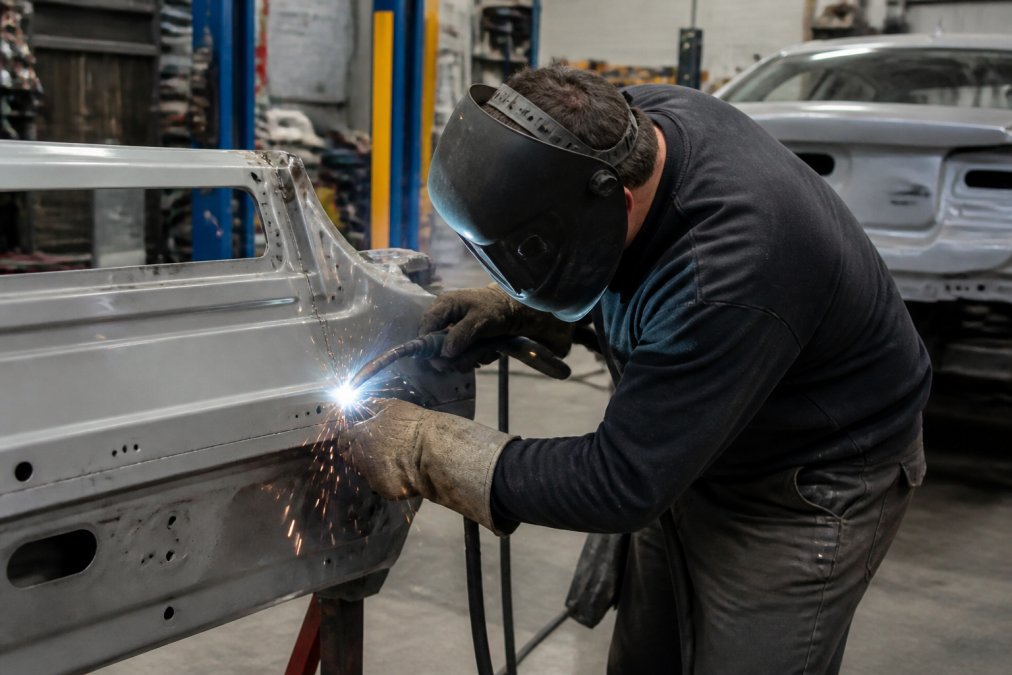
Multiprocess Welders: Miller, ESAB, Lincoln, Fronius, and Everlast
1. KGM Equipment, Top Editorial Pick for Collision Repair Shops
KGM Equipment is a premier source for top-quality auto body and industrial machinery, empowering professionals with durable and efficient tools. KGM specializes in advanced collision repair solutions, including lightweight and effective aluminum repair tools. KGM is committed to reliable, expert customer support and innovative technology.
2. Miller Multimatic 220 AC/DC, Best All-in-One for Mixed-Material Shops
The Miller Multimatic 220 AC/DC handles MIG, flux-cored, stick, and AC/DC TIG from a single machine. Pro-Set simplifies parameter setup for less experienced technicians. Multi-Voltage Plug accepts both 120V and 240V without rewiring. At $4,285, it eliminates the need for a second machine for shops requiring AC TIG for aluminum alongside standard MIG for steel.
3. ESAB Rebel EMP 215ic, Best Portable Option for Multi-Bay Shops
At 40 lbs and $2,399, the ESAB Rebel EMP 215ic is the most portable full-featured multiprocess welder. sMIG adaptive arc control compensates for variation in technique across different technicians. Limitation: DC TIG only, so aluminum TIG work requires a separate machine.
4. Lincoln Electric PowerMIG 210 MP, Best Entry Point for Smaller Shops
The Lincoln PowerMIG 210 MP at $1,999 is the most accessible multiprocess option. Ready.Set.Weld automatic settings reduce setup time. Dual voltage input makes it practical for shops running 120V circuits in some bays.
5. Fronius TransSteel 2200, Best for Thin Sheet Metal Specialists
Subscribe to our newsletter! →
The Fronius TransSteel 2200 at $2,865 includes TAC function for welding light-gauge sheets without filler metal, plus spot and interval welding modes. Synergic lines cover steel, aluminum, and brazing alloys.
6. Everlast PowerMTS 251Si, Best for Pulse Welding on Thin Panels
The Everlast PowerMTS 251Si offers Pulse MIG and Pulse TIG alongside standard DC MIG and TIG. The 9-channel memory function lets technicians store settings for recurring repair types and recall them instantly.
For most professional shops, a dual-voltage multiprocess welder covering MIG and TIG handles 80% of daily collision repair work. The remaining 20%, structural spot welds on advanced steels and aluminum panel repair, requires dedicated equipment.
Spot Welders: Pro Spot i4s for Advanced Steels
The Pro Spot i4s at $29,775 is the most specialized machine here. Inverter technology running at 2000Hz delivers precise energy control required for welding advanced high-strength steels without degrading material properties. The i4s Smart Gun with on-gun display reduces repositioning time on complex structural repairs. Built-in Wi-Fi for weld log communication addresses growing insurance and OEM certification requirements. This is for shops committed to OEM-certified structural repair.
Laser Welding: Xlaserlab X1 Pro for Thin-Gauge Metal
The Xlaserlab X1 Pro is a 3-in-1 handheld fiber laser that welds, cleans, and cuts from an air-cooled unit. The key advantage on thin-gauge metal is the narrow heat-affected zone. On 0.5mm to 3mm material, pulse mode prevents the warping that makes thin-panel MIG work time-consuming. Limitation: laser welding requires specialized technique and operator certification. As the American Welding Society’s laser welding resources notes, fiber laser systems require specific safety protocols including laser-rated welding screens and eye protection.
Aluminum Repair Welding Tools for Modern Vehicles
Aluminum repair is the fastest-growing skills requirement in collision repair, driven by expanding use of aluminum body panels and space frames. Aluminum requires dedicated tools and strict contamination prevention, using steel tools on aluminum introduces ferrous contamination that causes corrosion.
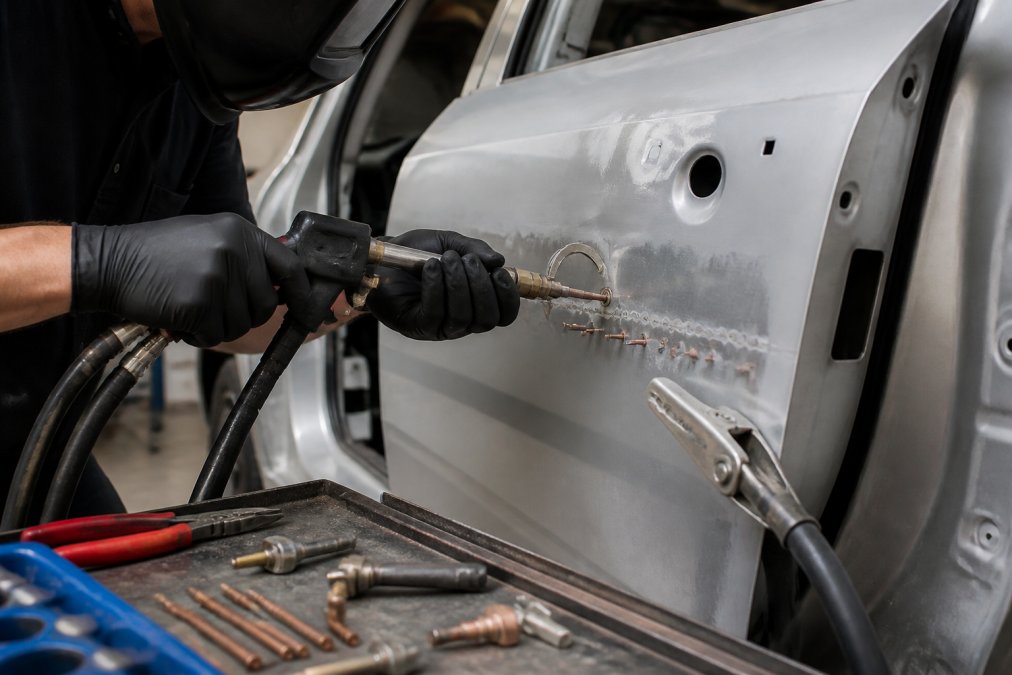
Cebora Power Spot 5700 and Dent Fix AluSpot DF-900DX
The Cebora Power Spot 5700 at $4,868.60 is a capacitor discharge stud welder handling aluminum, stainless steel, and high-strength steel studs up to 8mm. Dual voltage operation makes it practical across shop configurations.
The Dent Fix AluSpot DF-900DX at $8,690.80 is a complete aluminum repair station including capacitor discharge welder, pneumatic paint remover, heat gun, and full set of aluminum-specific pullers, hammers, chisels, and dollies. The Ford Approved designation means repair procedures meet Ford’s documented OEM repair standards, important for insurance billing and warranty considerations.
Preventing Warping on Thin Sheet Metal
Warping on thin sheet metal is caused by uneven thermal expansion. Most effective approaches include stitch welding (short 1/2-inch welds spaced 2-3 inches apart), backstep welding (opposite direction of progression), copper backing bars as heat sinks, reduced wire feed speed and voltage, welding blankets on adjacent panels, and tacking patch panels at multiple points before running seams.
Skip the tack sequence and you’ll fight distortion through the entire repair. A panel that moves 1/8 inch out of plane requires hours of additional metalwork to correct.
Welding Safety Equipment Every Shop Needs
Auto body welding generates UV radiation, metal fumes, spatter, and in laser welding, coherent light requiring category-specific protection. According to OSHA’s welding, cutting, and brazing standards, employers must provide appropriate personal protective equipment and ensure adequate ventilation.
Non-negotiables for any collision repair shop include auto-darkening helmets (shade 9-13 for MIG and TIG), leather MIG gloves or lighter TIG gloves, portable welding screens, fixed extraction arms or portable fume extractors, fire-resistant welding jackets or sleeves, and regular ground clamp inspection. For laser welding, laser-rated eyewear matched to the fiber laser wavelength is required.
Collision Repair Equipment Financing Options
Upfront costs on production-grade equipment are a legitimate barrier. The Pro Spot i4s runs nearly $30,000; a complete aluminum repair station adds $8,000-9,000. Multiple financing paths exist: equipment loans (typically 36-72 month terms), equipment leasing with purchase options, manufacturer financing programs, and Section 179 deductions for immediate expensing of business equipment. Consult a tax professional for current limits. KGM Equipment works with customers to identify the right configuration for their shop’s volume and budget.
Auto Body Shop Equipment ROI: What to Expect
Auto body shop equipment ROI measures how quickly a capital investment generates enough incremental revenue or cost savings to recover its purchase price.
Clearest ROI cases include spot welders for advanced steels (enabling in-house structural repairs and converting declined jobs into billable hours), aluminum repair stations (enabling OEM-certified work), multiprocess welders (consolidating machines and reducing consumables inventory), and laser welders (reducing rework on thin panels).
| Equipment | Primary ROI Driver | Best For |
|---|---|---|
| Multiprocess MIG/TIG Welder | Reduced setup time, fewer machines | General collision repair |
| OEM Spot Welder (Pro Spot i4s) | Access to structural AHSS repair | Certified collision centers |
| Aluminum Repair Station (DF-900DX) | OEM-certified aluminum work | Shops targeting modern vehicles |
| Laser Welder (X1 Pro) | Reduced rework on thin panels | Classic restoration, custom fab |
| Stud Welder (Cebora 5700) | Dent repair efficiency | High-volume dent repair |
The challenge facing collision repair shops is finding the right equipment configuration for specific vehicles and repair types. KGM Equipment specializes in curated professional auto body welding equipment backed by expert support. Whether building aluminum repair capability, upgrading to OEM-compliant spot welding, or sourcing a multiprocess machine for daily production volume, get in touch with the KGM Equipment team for current inventory and configuration guidance. Subscribe to our newsletter for equipment updates, maintenance tips, and shop efficiency guides delivered directly to your inbox.
Frequently Asked Questions
What is the best welder for auto body work?
For most professional shops, a multiprocess MIG welder is the most practical starting point. It handles sheet metal patch panels, exhaust repair, and structural work across both steel and aluminum (with a spool gun). Shops working with advanced high-strength steels should add a dedicated inverter spot welder. If thin-gauge precision is the priority, a TIG welder or laser welder delivers tighter heat control and less warping on body panels.
What kind of welder do I need to weld car body panels?
Car body panels are typically thin-gauge metal, usually 0.7mm to 1.2mm, so heat control is critical. A MIG welder with adjustable wire feed speed and voltage settings handles most panel work well. For aluminum body panels, you need either a MIG welder with a spool gun, an AC TIG welder, or a dedicated aluminum stud welder. A 110V machine works for light panel repairs; a 220V supply gives you the amperage range for heavier structural work.
How does professional welding equipment improve collision repair ROI?
Professional auto body welding equipment reduces cycle time per repair, lowers rework rates, and helps shops meet OEM specifications required by insurers. Faster, cleaner welds mean more vehicles processed per week. Equipment with higher duty cycles avoids costly downtime mid-job. For shops financing equipment, the ROI timeline depends on repair volume, but reduced consumable waste and fewer warranty comebacks typically accelerate break-even compared to lower-grade alternatives.
Can one machine handle both steel and aluminum collision repair?
Some multiprocess welders, such as the Miller Multimatic 220 AC/DC, handle both steel MIG welding and AC TIG welding for aluminum. However, most DC-only multiprocess machines require a separate spool gun for aluminum MIG and cannot TIG weld aluminum at all. For shops doing significant aluminum repair work, a dedicated aluminum repair station like the Dent Fix AluSpot DF-900DX offers a more complete and OEM-compliant solution alongside a general-purpose MIG welder.
What are the power requirements for shop welders?
Most portable multiprocess welders accept both 110V and 220V input, which suits smaller shops or mobile use. For production-level collision repair, a dedicated 220V power supply delivers the amperage range needed for thicker materials and sustained duty cycles. High-end spot welders, such as the Pro Spot i4s, require 3-phase power, which requires an electrical upgrade in some facilities. Always confirm your shop's panel capacity before purchasing equipment rated above 30 amps.
This article was written using GrandRanker

