

Table of Contents
- How Equipment Financing Works for Auto Body Shops
- Types of Auto Body Equipment Eligible for Financing
- Equipment Leasing vs Buying for Collision Repair
- Section 179 Tax Deduction for Auto Body Shops
- Auto Body Shop Equipment Loan Requirements and Approval
- Calculating ROI and Equipment Lifecycle Value
- Financing Your Shop’s Growth in 2026
- Frequently Asked Questions
Last Updated: September 22, 2026
How Equipment Financing Works for Auto Body Shops
Equipment financing allows auto body shops to acquire machinery, paint booths, lifts, and tools without paying upfront. Shops borrow funds and repay over 3-7 years instead of making a large capital expenditure.
A lender evaluates your creditworthiness and the equipment’s fair market value, then sets loan terms. You receive funds, purchase equipment, and make monthly principal-and-interest payments. The equipment serves as collateral.
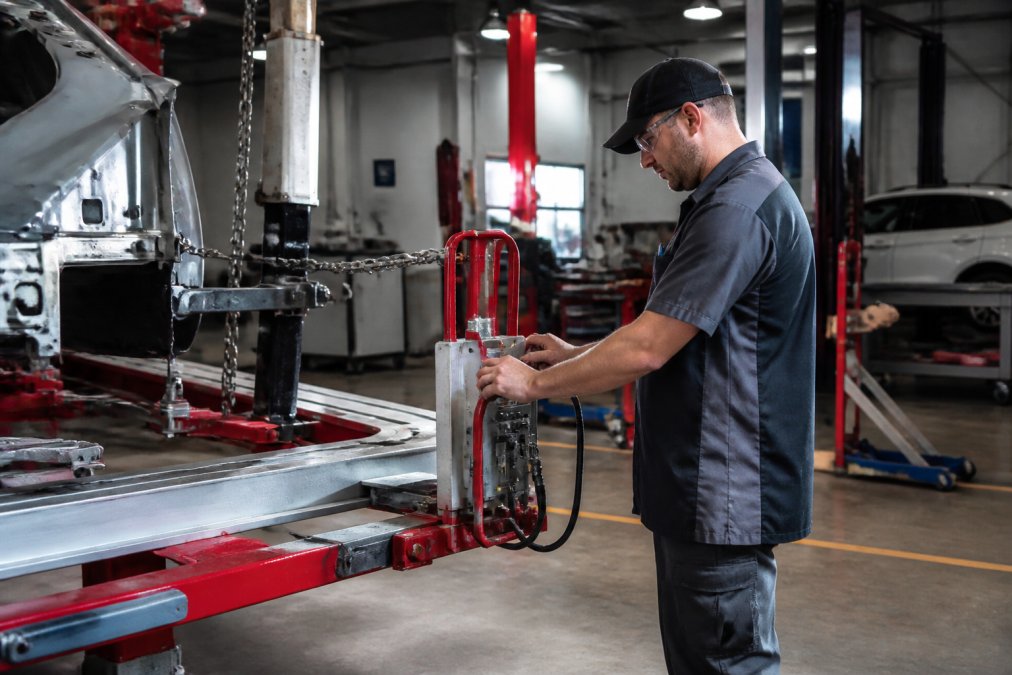
You preserve working capital while spreading machinery costs across years. A $50,000 paint booth becomes a manageable monthly payment rather than a single cash drain, especially valuable for multi-equipment expansion.
Pro Tip
The equipment itself becomes the loan’s security. Lenders are more comfortable financing tangible assets like lifts and welding equipment than unsecured loans, which often means better interest rates for auto body shops compared to general business loans.
The equipment itself becomes the loan’s security. Lenders are more comfortable financing tangible assets like lifts and welding equipment than unsecured loans, which often means better interest rates for auto body shops compared to general business loans.
Types of Auto Body Equipment Eligible for Financing
Most collision repair machinery qualifies for financing. Lenders finance equipment with resale value, predictable lifespan, and clear depreciation schedules.
Commonly financed equipment includes: Automotive lifts, frame machines, paint booths, spray equipment, baking ovens, welding systems, diagnostic equipment, alignment machines, and air compressors. All have resale value and clear depreciation schedules.
Some lenders finance consumables bundled with equipment purchases, though ongoing material costs typically aren’t eligible.
Lenders finance capital equipment with useful life of several years and clear resale value. They won’t finance routine supplies, labor, or working capital needs. Collision repair tools and lifts qualify; payroll coverage requires a line of credit.
Key Takeaway
The equipment must have tangible value and a secondary market. Specialized auto body equipment generally qualifies because shops regularly buy and sell used machinery. Generic office furniture may not, depending on the lender’s criteria.
The equipment must have tangible value and a secondary market. Specialized auto body equipment generally qualifies because shops regularly buy and sell used machinery. Generic office furniture may not, depending on the lender’s criteria.
Equipment Leasing vs Buying for Collision Repair
The leasing versus buying decision affects cash flow, tax position, and flexibility. The choice depends on whether you finance through a manufacturer or independent lender, and current economic conditions.
Buying equipment through third-party financing means securing a loan from a bank, credit union, or equipment finance company. You own the asset after payoff, build equity, and control maintenance. You’re responsible for all repairs and bear obsolescence risk. For stable shops planning long-term use, ownership makes financial sense. Third-party lenders offer 3-7 year terms, financing 70-90% of value with 10-30% down.
Buying equipment through vendor-direct financing offers lower rates than third-party lenders because manufacturers know equipment value and can repossess easily. Vendor programs may bundle maintenance, reducing repair costs. Trade-off: you’re locked into that manufacturer’s ecosystem, and early payoff may carry penalties. Vendor programs are typically 0.5-2% cheaper on APR.
Operating leases let you pay monthly without owning. The lessor handles maintenance and upgrades. This preserves capital and avoids obsolescence risk.
| Approach | Monthly Cost | Maintenance | Ownership | Equity Build | Best For |
|---|---|---|---|---|---|
| Third-Party Equipment Financing | Fixed payment | You manage | Yes, after payoff | Yes | Stable shops, long-term use, lower total cost |
| Vendor-Direct Financing | Fixed payment | Often included | Yes, after payoff | Yes | Manufacturer ecosystem, bundled support |
| Operating Lease | Fixed payment | Included | No | No | Flexibility, technology changes, avoid repairs |
| Capital Lease | Fixed payment | Varies | Option at end | Partial | Hybrid approach, test before buy |
Pro Tip
Before signing any lease or financing agreement, calculate the total cost of ownership across the equipment’s useful life. For a $50,000 paint booth with a 10-year lifespan, compare: (a) third-party loan at 8% APR over 5 years plus maintenance costs, (b) vendor financing at 6.5% APR with included maintenance, and (c) operating lease at $900/month. The lowest monthly payment isn’t always the lowest total cost.
Before signing any lease or financing agreement, calculate the total cost of ownership across the equipment’s useful life. For a $50,000 paint booth with a 10-year lifespan, compare: (a) third-party loan at 8% APR over 5 years plus maintenance costs, (b) vendor financing at 6.5% APR with included maintenance, and (c) operating lease at $900/month. The lowest monthly payment isn’t always the lowest total cost.
Section 179 Tax Deduction for Auto Body Shops
The Section 179 deduction allows businesses to deduct the full purchase price of qualifying equipment in a single year rather than depreciating it over time, providing substantial tax savings for auto body shops.
Watch Out
Section 179 deductions require careful planning with your accountant. Taking the full deduction in a single year might push you into a higher tax bracket or affect other tax benefits. Spreading deductions across years through depreciation may sometimes be advantageous. Always consult a tax professional before making equipment decisions based on Section 179 strategy.
Section 179 deductions require careful planning with your accountant. Taking the full deduction in a single year might push you into a higher tax bracket or affect other tax benefits. Spreading deductions across years through depreciation may sometimes be advantageous. Always consult a tax professional before making equipment decisions based on Section 179 strategy.
Auto Body Shop Equipment Loan Requirements and Approval
Lenders focus on three factors: creditworthiness, equipment value, and debt service capacity.
Calculating ROI and Equipment Lifecycle Value
Justifying equipment financing requires understanding the return on investment and the equipment’s productive lifespan. This analysis separates smart capital investments from expensive mistakes.
Subscribe to our newsletter! →
Pro Tip
Track equipment performance metrics for 90 days after installation. Measure actual cycle time reduction, defect rates, and labor hours. Compare against your pre-purchase baseline. This real data validates your ROI assumptions and informs future equipment decisions.
Track equipment performance metrics for 90 days after installation. Measure actual cycle time reduction, defect rates, and labor hours. Compare against your pre-purchase baseline. This real data validates your ROI assumptions and informs future equipment decisions.
Financing Your Shop’s Growth in 2026
The 2026 economic environment presents specific opportunities and constraints for shop expansion. Understanding the lending landscape and positioning your equipment investment determines approval odds and terms.
2026 Interest Rate and Lending Environment
Connecting Equipment ROI to Financing Approval
Phased Growth Strategy for 2026
Vendor-Direct Financing as a Growth Tool
2026 Approval Checklist
- Document baseline metrics (cycle times, defect rates, labor hours). Lenders want ROI, not just need.
- Ensure DSCR is 1.25+. Below 1.2 requires improving cash flow first.
- Gather 2-3 years of tax returns and recent P&L statements.
- Compare vendor-direct financing against bank loans and calculate total cost of ownership.
- Time your application during peak season when cash flow and profitability are highest.
- Consider smaller down payment if it preserves working capital. Financing 85% at slightly higher rate may beat depleting reserves.
Watch Out
Don’t apply for multiple loans simultaneously in 2026. Each application generates a hard credit inquiry, and multiple inquiries within 30 days can lower your credit score by 5-10 points. This affects approval odds and rates. If you’re comparing lenders, do so within a 14-day window so inquiries count as a single rate-shopping event.
Don’t apply for multiple loans simultaneously in 2026. Each application generates a hard credit inquiry, and multiple inquiries within 30 days can lower your credit score by 5-10 points. This affects approval odds and rates. If you’re comparing lenders, do so within a 14-day window so inquiries count as a single rate-shopping event.
Pro Tip
After equipment installation, track actual performance against your pre-purchase projections for 90 days. Measure cycle time reduction, defect rates, and labor hours. If the equipment underperforms, address it immediately (calibration, training, workflow changes). If it outperforms, document this for future financing applications, it strengthens your credibility with lenders.
After equipment installation, track actual performance against your pre-purchase projections for 90 days. Measure cycle time reduction, defect rates, and labor hours. If the equipment underperforms, address it immediately (calibration, training, workflow changes). If it outperforms, document this for future financing applications, it strengthens your credibility with lenders.
Frequently Asked Questions
What’s the difference between a capital lease and an operating lease for collision repair equipment?
A capital lease transfers ownership risk to you and appears on your balance sheet as an asset, making you responsible for maintenance and repairs. An operating lease is a short-term rental where the lessor retains ownership, handles maintenance, and typically costs less monthly. For auto body equipment financing, capital leases work better if you plan to keep machines long-term, while operating leases suit shops that upgrade equipment frequently or want predictable monthly expenses without ownership obligations.
How does Section 179 tax deduction for auto body shops help reduce equipment costs?
Section 179 allows you to deduct the full purchase price of qualifying equipment in the year you buy it, rather than depreciating it over several years. For auto body shops, this means if you purchase a $50,000 paint booth or frame machine, you can deduct the entire amount from your business income that year, potentially lowering your tax liability significantly. This accelerates tax savings and improves cash flow, making equipment financing more affordable when combined with a loan.
What documents do I need to apply for auto body shop equipment loan requirements?
Most lenders require business tax returns (2-3 years), personal credit reports, a business plan or equipment purchase proposal, bank statements showing working capital, and proof of business ownership. For collision repair equipment specifically, lenders often want equipment quotes or appraisals to confirm the asset’s value and collateral potential. Some lenders also request your debt service coverage ratio and details on existing business debt to assess your ability to repay.
How long does approval typically take for auto body equipment financing?
Approval timelines vary by lender and loan type. Traditional bank term loans often take 2-4 weeks, while equipment-specific lenders may approve in 5-10 business days. Lines of credit can be faster, sometimes approved within days. Vendor-direct financing through equipment suppliers may offer same-day or next-day approval for smaller purchases. Having all required documents ready upfront, tax returns, bank statements, and equipment specs, significantly speeds the process.
Can I get equipment financing with bad credit for my body shop?
Yes, but expect higher interest rates and stricter terms. Bad credit typically means rates 2-5% higher than prime lending rates. Some equipment-specific lenders focus on business cash flow rather than personal credit scores, making them more flexible. You may need a larger down payment, a personal guarantee, or collateral beyond the equipment itself. Working with a lender experienced in auto body shop financing increases approval odds, as they understand your industry’s revenue patterns and equipment ROI.
What’s the real ROI timeline before equipment financing breaks even for a collision repair shop?
ROI depends on equipment type and shop volume. Frame machines and automotive lifts typically pay for themselves in 18-36 months through faster cycle times and increased throughput. Paint booths may break even in 24-48 months when factoring in material savings and quality improvements. Aluminum repair equipment shows ROI in 12-24 months if your shop handles significant aluminum work. Calculate your shop’s current labor costs per job, estimate time savings with new equipment, and compare that to monthly financing payments to determine your specific breakeven point.
Should I refinance existing equipment financing if interest rates drop?
Refinancing makes sense if you can lower your interest rate by at least 1-2% and have enough remaining loan term to recover refinancing costs. Calculate the difference between your current monthly payment and the new payment, then divide refinancing fees by that monthly savings to find your breakeven point. For auto body equipment with 3-5 year remaining terms, refinancing can save thousands. However, if you’re near the end of your loan term, the savings may not justify the application fees and credit inquiry.
